School districts struggling to get reserves cap repealed
 Source: California Aqueduct webcast
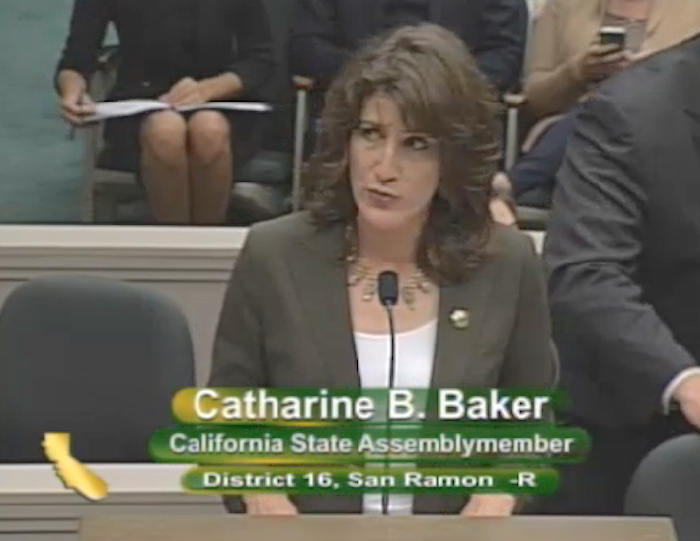
Catharine Baker appeals to members of the Assembly Education Committee to pass AB 1048, her bill to rescind the cap on district reserves.
Advocates for school districts are still hoping they can persuade legislative leaders and the governor to repeal the limit on how much money districts can annually continue in reserve. And so far, though, they've struck out.
Terminal week, on a party-line vote, the majority Democrats on the Assembly Education Committee rejected Associates Pecker 1048, sponsored by Assemblywoman Catharine Baker, R-Dublin. The bill would have rescinded the reserve cap, which has yet to go into effect. Democrats and Republicans disagreed on how much of a problem, if any, the ceiling on reserves volition create. A Senate version of the neb, sponsored by Sen. Jean Fuller, R-Bakersfield, failed to move out of that trunk'due south Educational activity Commission.
School management groups were incensed over a last-minute deal last year in whichDemocratic leaders and Gov. Jerry Dark-brown attached the cap on district reserves to the pecker containing legal linguistic communication associated with the state upkeep, called the trailer bill, without a hearing. The school direction groups say they didn't learn about the cap until shortly before the vote on the budget.
The California School Boards Clan blamed the California Teachers Association for persuading Democratic leaders to include the cap as a fashion to free up money tied up in reserves so that it would exist bailiwick to contract negotiations. The CTA, while non publicly taking credit for orchestrating the deal, is the chief opponent to rescinding the cap. The schoolhouse boards clan said the ceiling on reserves violated local control over local budgets – the principle behind the Local Control Funding Formula – and has fabricated rescission its top priority this year.
Baker, in a hearing on her nib last week, called the cap "a destabilizing policy nosotros have imposed on every commune in the state."
Under current law, districts must maintain minimum cease-of-twelvemonth balances in their general funds, ranging from 1 pct for Los Angeles Unified to 5 percentage for the smallest districts. The cap on reserves would range from 3 percent for L.A. Unified to 10 pct for small districts of nether one,000 students.
CTA lobbyist Estelle Lemieux said it was "unconscionable" for districts to hoard money in reserves that taxpayers wait to be spent on education programs.
The Legislative Annotator'south Function, which also has called for the cap'due south rescission in a Jan 2022 study, found that fewer than ten pct of the about 1,000 districts in the land would accept met the new cap requirement had information technology been in effect in 2013-14. Faced with large cuts in state funding following the 2008 recession, as well as incertitude near whether there would be further cuts if voters failed to pass temporary taxes under Proffer 30 in 2012, most districts built up double-digit reserves. In 2013-14, according to the LAO, reserves averaged 66 per centum of general fund expenditures for pocket-sized districts, 21 percent for mid-sized districts and xv percent for big districts.
Country revenues accept surged the past two years, but school boards and superintendents argue they remain subject to volatile country taxes and a possible decline in state revenue when Prop. xxx is phased out over the next iii years. Districts, they argue, should determine their own reserve levels, based on individual circumstances that they, not Sacramento politicians, know best.
Just CTA lobbyist Estelle Lemieux said it was "unconscionable" for districts to hoard money in reserves that taxpayers expect to exist spent on education programs. Districts laid off librarians, counselors and nurses at the same time they were building huge surpluses, she said.
The cap on reserves would go into result the year after the land makes payment of any size into a new rainy day fund for 1000-12 and community colleges that's part of Proposition ii, which voters passed last year. The rationale backside the cap is that districts wouldn't need large reserves if the state also has a rainy mean solar day fund to absorber revenue declines.
Contributions into the land pedagogy rainy day fund would be rare, however. Revenue from the capital gains revenue enhancement would have to be above boilerplate, and all debts owed to schools under Proposition 98, called the maintenance factor, would have to be paid off. The LAO, in the latest analysis of the May budget revision, predicts no contributions to the rainy 24-hour interval fund – and no triggering of the reserve cap – for at least the next three years. In its analysis of the May budget revision, School Services of California, a Sacramento-based pedagogy consulting firm, concluded that there is an exterior chance that the reserve cap could be enacted next year.
Just Josh Daniels, an attorney and a fellow member of the Berkeley Unified school lath, testified at the AB 1048 hearing that the mere existence of the reserve cap constabulary is already creating damage. The bond rating agency Standard & Poor's cited the cap every bit one reason to deny his district a amend credit rating, which could have saved Berkeley taxpayers potentially millions of dollars in lower interest payments, Daniels said. Not knowing when the cap may exist triggered is prompting some districts to lower reserves despite their better judgment, the school boards clan has argued.

Source: California Channel webcast.
Assemblyman Patrick O'Donnell, who chairs the Associates Education Committee, said there has been misinformation about the need for the repeal.
Democrats counter that worries about the reserve cap are overblown, based on what the chair of the Associates Educational activity Committee, Patrick O'Donnell, D-Long Beach, called "defoliation and misinformation." O'Donnell, a teacher and former CTA leader, said that a commune could appeal to its local county part of teaching to grant a i-year waiver from the reserve restriction. And a school board could designate savings for specific purposes, such as new computers, schoolhouse buses or a roof replacement, that wouldn't count toward the reserve cap. To emphasize the point, O'Donnell has sponsored AB 531, confirming that committed reserves are an option that districts can use.
Only Daniels called committed reserves "a crimson herring" that appears to give districts flexibility the Legislature took away with the reserve cap. Rescinding the cap is the simply style to make things right, he and others say.
Dennis Meyers, a lobbyist for the school boards association, said he and other school groups will continue to make their example to the Brown administration for a solution, although CTA is not likely to give up the cap without getting something in render. It's non clear what the price will exist to make it vanish.
To get more reports similar this ane, click hither to sign upwardly for EdSource'due south no-toll daily email on latest developments in didactics.
Source: https://edsource.org/2015/school-district-advocates-pushing-to-repeal-cap-on-budget-reserves/80109

Post a Comment for "School districts struggling to get reserves cap repealed"