Pew Center for Arts and Heritage Public Opinion Data in Modern Politics Us
I. Executive Summary
 The American religious landscape is undergoing a dramatic transformation. White Christians, one time the ascendant religious group in the U.S., now account for fewer than half of all adults living in the country. Today, fewer than one-half of all states are majority white Christian. As recently equally 2007, 39 states had bulk white Christian populations. These are two of the major findings from this written report, which is based on findings from PRRI's 2016 American Values Atlas, the unmarried largest survey of American religious and denominational identity always conducted. This landmark report is based on a sample of more than 101,000 Americans from all 50 states and includes detailed information about their religious affiliation, denominational ties, political affiliation, and other important demographic attributes.
Amongst the major findings:
- White Christians now account for fewer than half of the public. Today, only 43% of Americans identify as white and Christian, and only 30% as white and Protestant. In 1976, roughly viii in 10 (81%) Americans identified as white and identified with a Christian denomination, and a majority (55%) were white Protestants.
- White evangelical Protestants are in decline—forth with white mainline Protestants and white Catholics.White evangelical Protestants were one time thought to exist bucking a longer trend, but over the past decade their numbers have dropped essentially. Fewer than one in five (17%) Americans are white evangelical Protestant, merely they accounted for almost one-quarter (23%) in 2006. Over the aforementioned catamenia, white Catholics dropped five pct points from sixteen% to eleven%, as have white mainline Protestants, from 18% to 13%.
- Non-Christian religious groups are growing, but they still represent less than ane in 10 Americans combined. Jewish Americans constitute 2% of the public while Muslims, Buddhists, and Hindus each constitute only 1% of the public. All other non-Christian religions constitute an boosted 1%.
- America's youngest religious groups are all non-Christian.Muslims, Hindus, and Buddhists are all far younger than white Christian groups. At least one-3rd of Muslims (42%), Hindus (36%), and Buddhists (35%) are under the historic period of 30. Roughly one-third (34%) of religiously unaffiliated Americans are as well nether 30. In contrast, white Christian groups are aging. Slightly more than 1 in ten white Catholics (11%), white evangelical Protestants (eleven%), and white mainline Protestants (14%) are under thirty. Approximately six in x white evangelical Protestants (62%), white Catholics (62%), and white mainline Protestants (59%) are at least 50 years sometime.
- The Catholic Church is experiencing an ethnic transformation.20-five years ago, nearly nine in x (87%) Catholics were white, non-Hispanic, compared to 55% today. Fewer than iv in ten (36%) Catholics under the age of 30 are white, non-Hispanic; 52% are Hispanic.
- Atheists and agnostics account for a minority of all religiously unaffiliated. Nearly are secular.Atheists and agnostics account for only about ane-quarter (27%) of all religiously unaffiliated Americans. Most six in ten (58%) religiously unaffiliated Americans identify equally secular, someone who is not religious; sixteen% of religiously unaffiliated Americans nonetheless report that they identify as a "religious person."
- There are xx states in which no religious group comprises a greater share of residents than the religiously unaffiliated.These states tend to be more concentrated in the Western U.Southward., although they include a couple of New England states, likewise. More than four in ten (41%) residents of Vermont and approximately one-third of Americans in Oregon (36%), Washington (35%), Hawaii (34%), Colorado (33%), and New Hampshire (33%) are religiously unaffiliated.
- No state is less religiously diverse than Mississippi.The state is heavily Protestant and dominated by a single denomination: Baptist. Six in 10 (60%) Protestants in Mississippi are Baptist. No state has a greater caste of religious variety than New York.
- The cultural eye of the Catholic Church is shifting s.The Northeast is no longer the epicenter of American Catholicism—although at 41% Catholic, Rhode Island remains the nearly Catholic state in the country. Immigration from predominantly Catholic countries in Latin America means new Catholic populations are settling in the Southwest. In 1972, roughly seven in x Catholics lived in either the Northeast (41%) or the Midwest (28%). But about 1-third of Catholics lived in the S (thirteen%) or West (xviii%). Today, a majority of Catholics now reside in the South (29%) or West (25%). Currently, only about one-quarter (26%) of the U.S. Catholic population lives in the Northeast, and 20% live in the Midwest.
- Jews, Hindus, and Unitarian-Universalists stand out equally the most educated groups in the American religious mural.More than one-third of Jews (34%), Hindus (38%), and Unitarian-Universalists (43%) hold postal service-graduate degrees. Notably, Muslims are significantly more than probable than white evangelical Protestants to take at least a four-year college caste (33% vs. 25%, respectively).
- Asian or Pacific-Islander Americans accept a significantly different religious profile than other racial or indigenous groups. There are equally many Asian or Pacific-Islander Americans affiliated with non-Christian religions as with Christian religious groups. And 1-third (34%) are religiously unaffiliated.
- About half of LGBT Americans are religiously unaffiliated. Almost half (46%) of Americans who identify as lesbian, gay, bisexual, or transgender (LGBT) are religiously unaffiliated. This is roughly twice the number of Americans overall (24%) who are religiously unaffiliated.
- White Christians have get a minority in the Democratic Party. Fewer than i in iii (29%) Democrats today are white Christian, compared to half (50%) one decade earlier. Just 14% of young Democrats (historic period 18 to 29) place as white Christian. Forty percent place as religiously unaffiliated.
- White evangelical Protestants remain the dominant religious force in the GOP. More than one-tertiary (35%) of all Republicans identify equally white evangelical Protestant, a proportion that has remained roughly stable over the past decade. Roughly 3-quarters (73%) of Republicans belong to a white Christian religious group.
2. A Portrait of Religious Affiliation in America
The American religious landscape has undergone dramatic changes in the last decade and is more diverse today than at whatsoever time since modernistic sociological measurements began.
White Christians, which once dominated the religious landscape as recently as a decade agone, now account for fewer than half of the public. White evangelical Protestants, the single largest religious tradition, make upwards less than ane in 5 (17%) Americans today. Compared to ten years ago, significantly fewer Americans identify equally white mainline Protestant (13%) or white Catholic (xi%). Mormons comprise two percent of the population.1
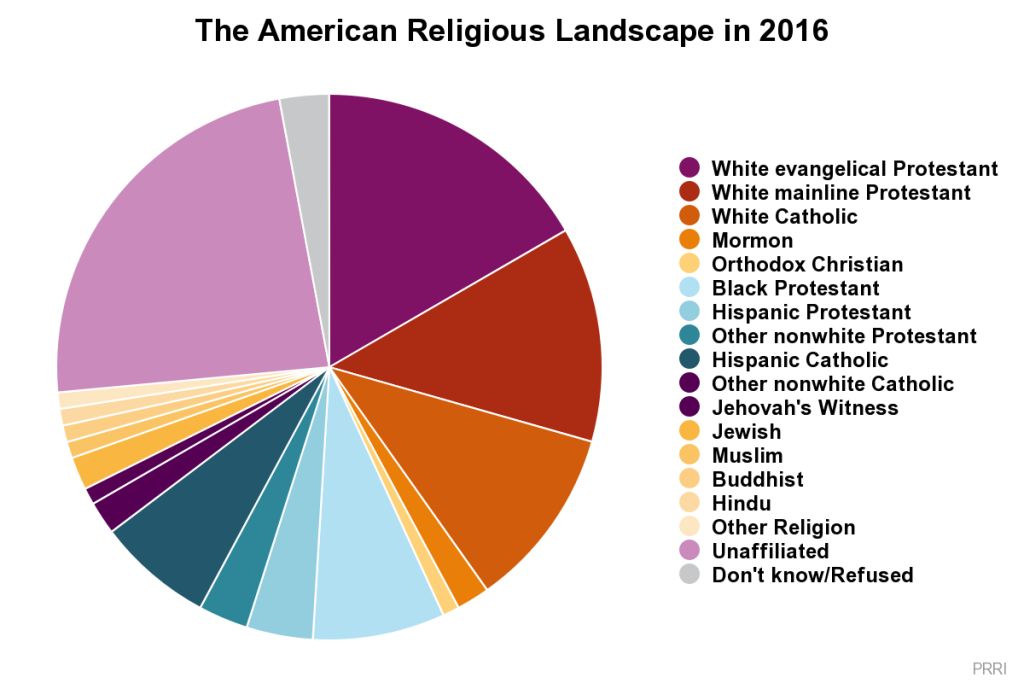
Xv per centum of Americans are nonwhite Protestants, including black Protestants (eight%), Hispanic Protestants (4%), and Asian, mixed-race, and other race Protestants (3%). Seven percentage of the public is Hispanic Catholic.
Non-Christian religious groups establish less than 1 in 10 Americans. Muslims, Buddhists, and Hindus are each roughly one percent of the population. Jewish Americans business relationship for two percent of the public.
No religious group is larger than those who are unaffiliated from religion. Nearly one in four (24%) Americans are now religiously unaffiliated.
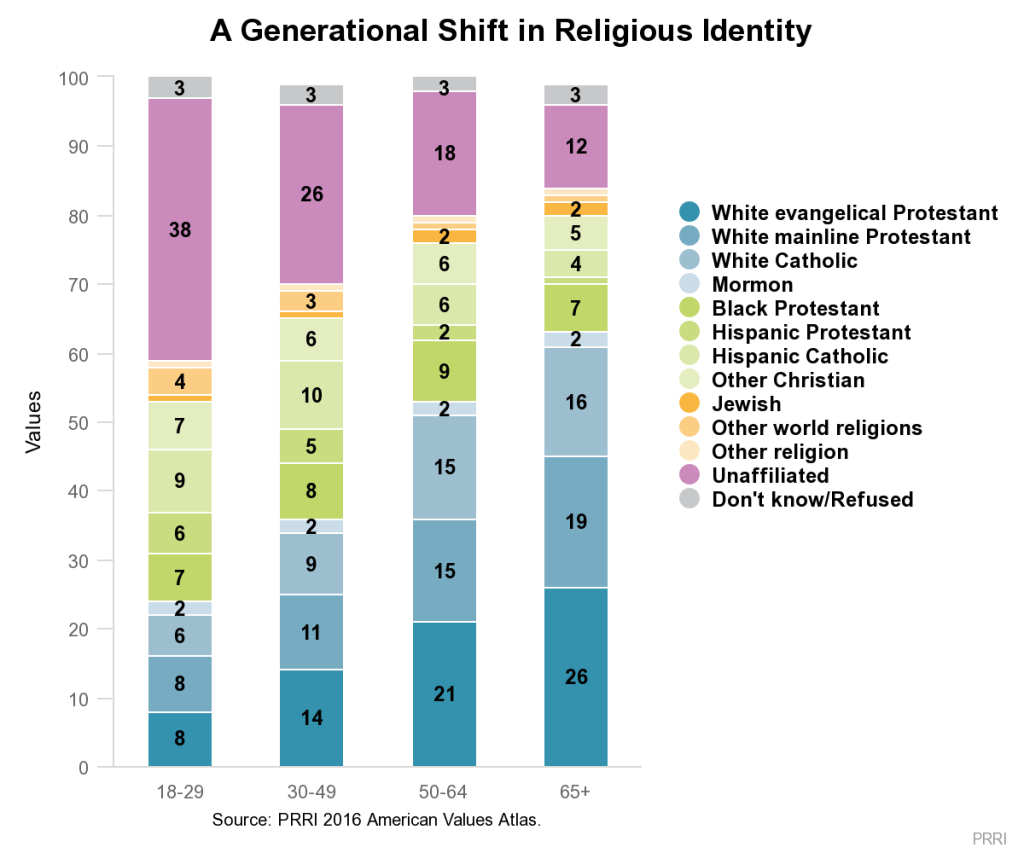
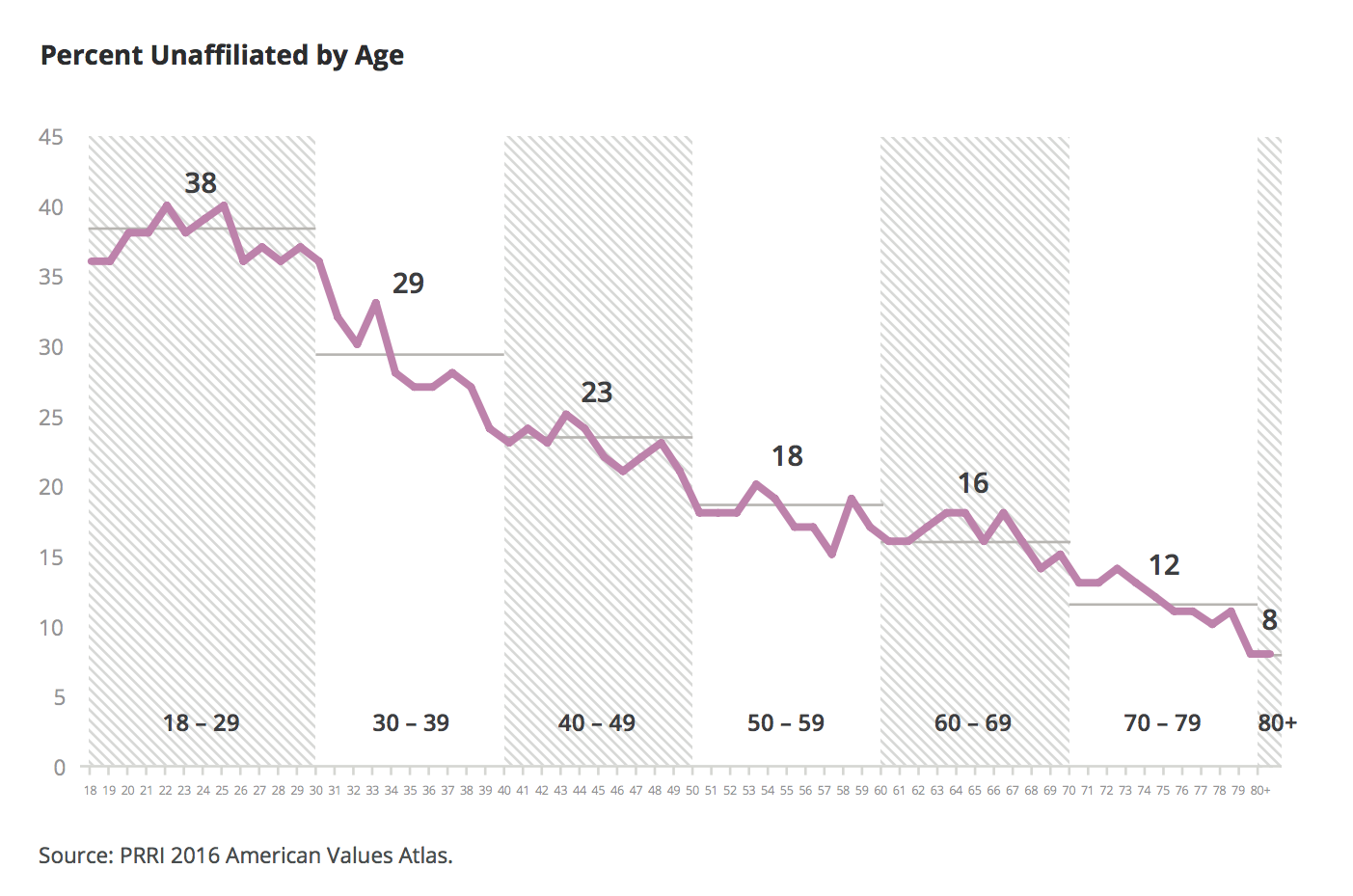
The religious landscape in the U.S. is highly stratified by generation. Nearly two-thirds of seniors (age 65 or older) identify as white and Christian: White evangelical Protestant (26%), white mainline Protestant (19%), or white Catholic (16%). Conversely, only about ane-quarter of young adults (age 18-29) vest to a white Christian tradition, including white evangelical Protestant (8%), white mainline Protestant (viii%), or white Catholic (6%). Immature adults are more than than iii times as probable as seniors to identify as religiously unaffiliated (38% vs. 12%, respectively).
 The Geography of Religion in America
There is substantial variation in religious identity betwixt the four regions of the Us. Collectively, white evangelical Protestants are twice as large in the South (22%) and Midwest (20%) as they are in the Northeast (viii%). Twelve percentage of residents in the West are white evangelical Protestant. In contrast, Catholics represent a much larger share of Northeastern residents. Roughly three in ten (29%) residents of the Northeast identify as Catholic, compared to about one in five Westerners (21%), Midwesterners (19%), and Southerners (17%). The religiously unaffiliated represent a larger share of the population in the West (29%) than in the Northeast (24%), Midwest (23%), or South (20%).
Notably, at that place is significant racial and ethnic variation among Catholics by region. White Catholics outnumber Hispanic Catholics by a wide margin in the Northeast (20% vs. 7%, respectively) and Midwest (fifteen% vs. 3%, respectively). Yet, in the South, residents are most as probable to identify as white Catholic (viii%) as they are to identify as Hispanic Catholic (7%); and in the West, Hispanic Catholics (12%) outnumber white Catholics (7%).
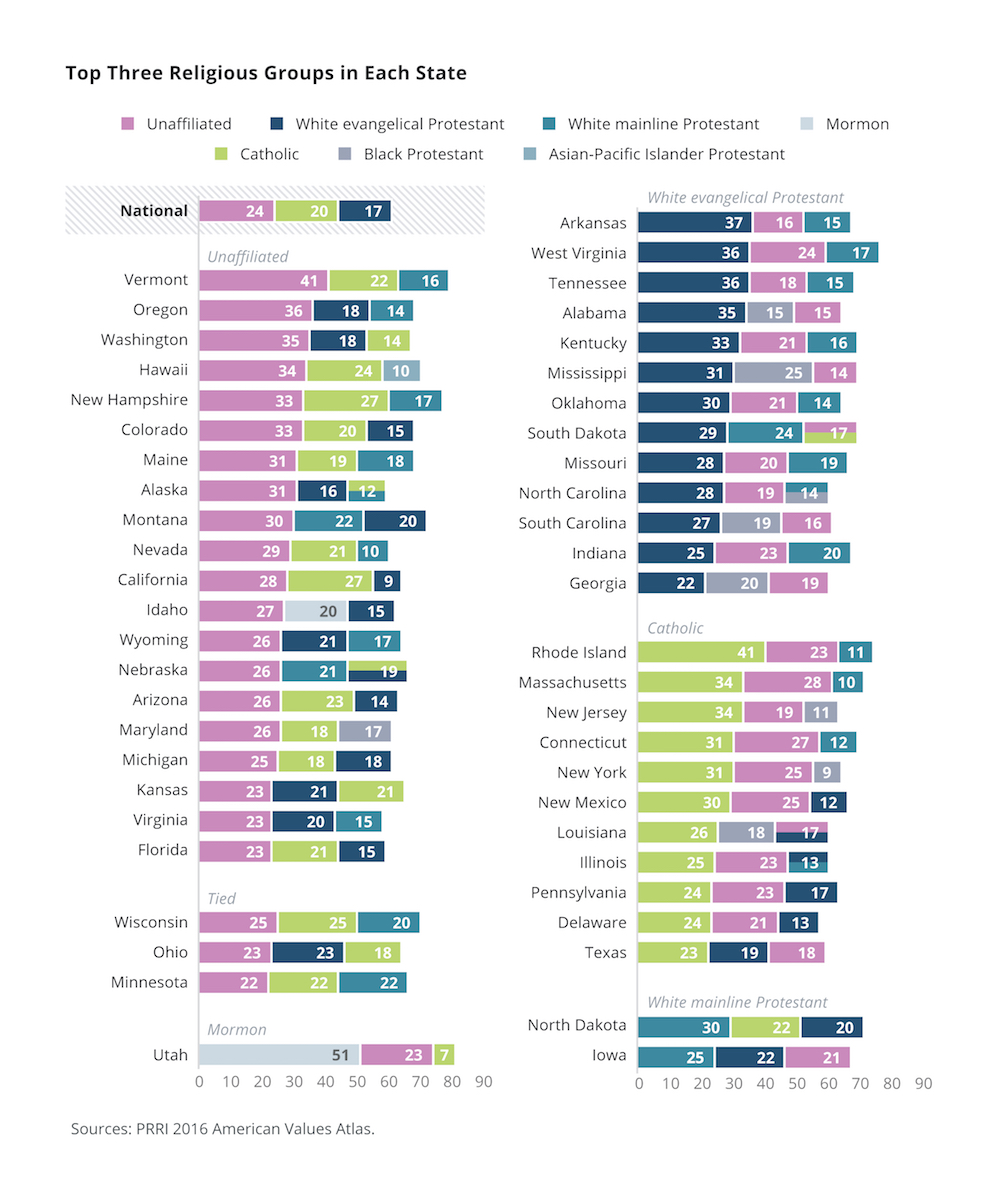
In that location are substantial differences in the religious profiles of the 50 states, although they follow regional patterns. There are 20 states in which no religious grouping comprises a greater share of residents than the religiously unaffiliated. These states tend to be more than concentrated in the Western U.Due south., although they include a couple of New England states, as well. More than than four in ten (41%) residents of Vermont and approximately one-3rd of Americans in Oregon (36%), Washington (35%), Hawaii (34%), Colorado (33%), and New Hampshire (33%) are religiously unaffiliated.
In xi states, many of which are clustered in the Northeast, no religious group outnumbers Catholics. No land has a higher concentration of Catholics than Rhode Island (41%), followed past Massachusetts (34%), New Bailiwick of jersey (34%), New York (31%), and Connecticut (31%).
In thirteen states, no religious group comprises a larger share of residents than white evangelical Protestants. Unsurprisingly, most of these states can exist establish in the South. At least one-tertiary of the residents in the following states are white evangelical Protestant: Arkansas (37%), West Virginia (36%), Tennessee (36%), Alabama (35%), and Kentucky (33%). Additionally, Mormons (51%) are the largest religious group in Utah, ane of the nearly religiously homogeneous states in the country.
White mainline Protestants are more numerous in North Dakota than any other state, making upwardly 30% of the country's residents.
Black Protestants are most dominant in Mississippi, where they brand upward one-quarter (25%) of the population, but they are still only the 2d largest religious group in the state behind white evangelical Protestants (31%).
Religious Diversity
Despite the incredible multifariousness of religious expression and identity in the U.S., there are importance differences in the degree of religious multifariousness found in each state. To measure the religious diversity in the state, this study uses an index developed to measure variations in the concentration of global religious populations.2 The index is calculated so that a score of "1" signifies complete diversity—every religious group is of equal size—while a score of "zip" indicates a complete lack of diversity and one religious group comprises the unabridged population of a given state.
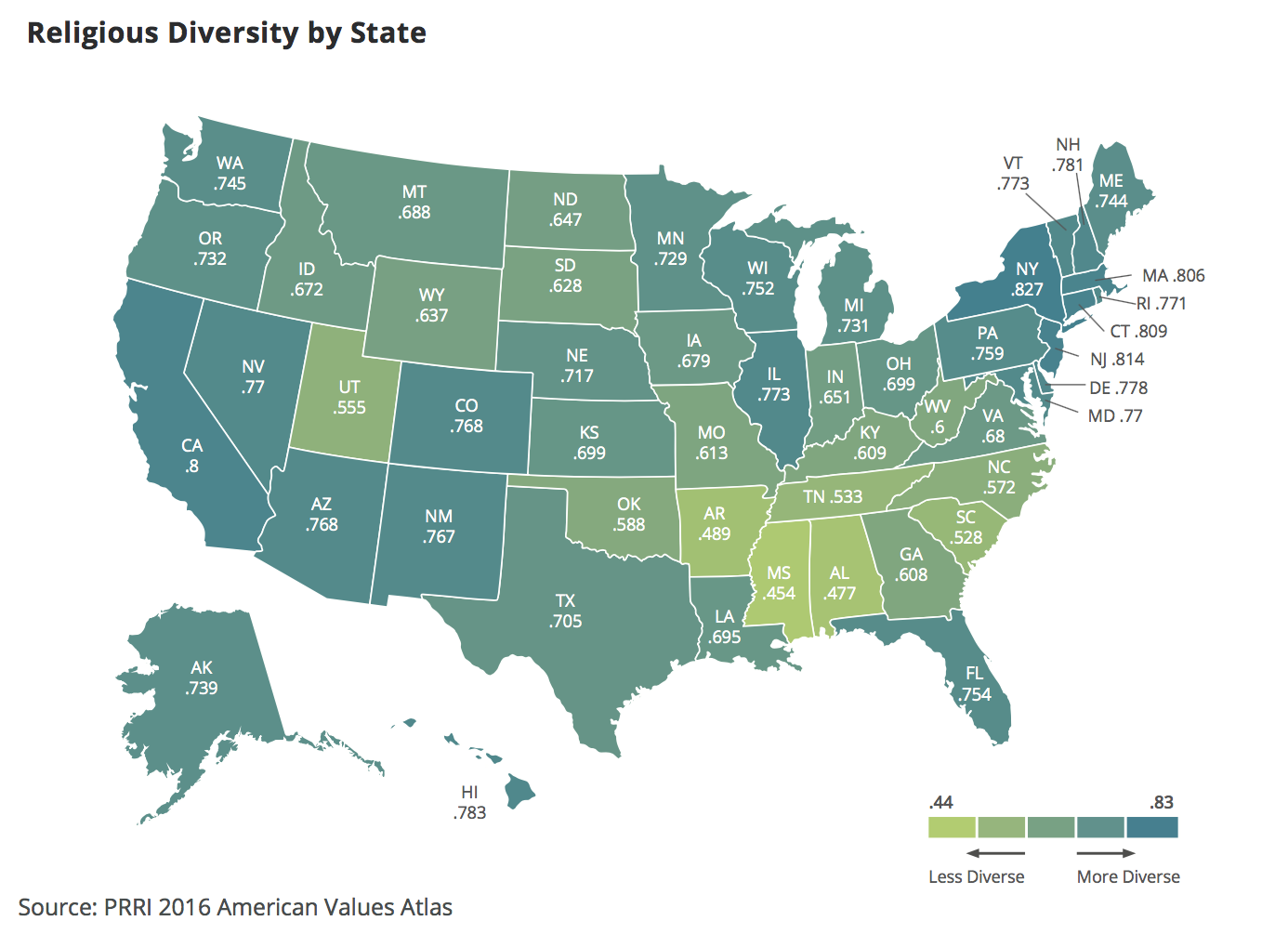
The least religiously various states in the U.South. are all located in the South. Mississippi is the least diverse land in the U.Due south. (0.45), followed by Alabama (0.48), Arkansas (0.49), South Carolina (0.53), and Tennessee (0.53). Conversely, the nearly religiously diverse states are primarily located in the Northeastern U.Due south., with New York (0.83), New Jersey (0.81), Connecticut (0.81), Massachusetts (0.81), and California (0.8) registering the greatest degree of religious variety.
Protestant Denominations
Among Protestants in the U.S., Baptists are the largest denominational family. Roughly i-third (32%) of all Protestants identify with some Baptist denomination, at least 3 times the number who identify with the next largest denominational families—Methodist (ten%), Pentecostal (10%), and Lutheran (viii%). One in twenty place with the Church of Christ or Disciples of Christ (5%) denominations or with the Presbyterian denomination (five%). Only 3 percent of Protestants vest to an Episcopalian or Anglican denomination. Notably, most one in five (17%) Protestants belong to independent Christian churches that are non affiliated with whatever Protestant denomination.
The pattern of denominational membership among Protestants varies significantly by region. More than four in ten (44%) Protestants living in the South chapter with a Baptist denomination, well-nigh twice as many as those living in the Northeast (23%), Midwest (23%), or West (nineteen%). Lutherans remain much more prevalent in the Midwest than any other function of the country. Seventeen per centum of Protestants living in the Midwest are Lutheran, roughly twice the number who identify with this denomination in the Westward (9%) and the Northeast (7%). Only three pct of Southerners are Lutheran. Not-denominational Protestants are more prevalent in the West (25%) than the Midwest (17%), South (15%), or Northeast (14%).
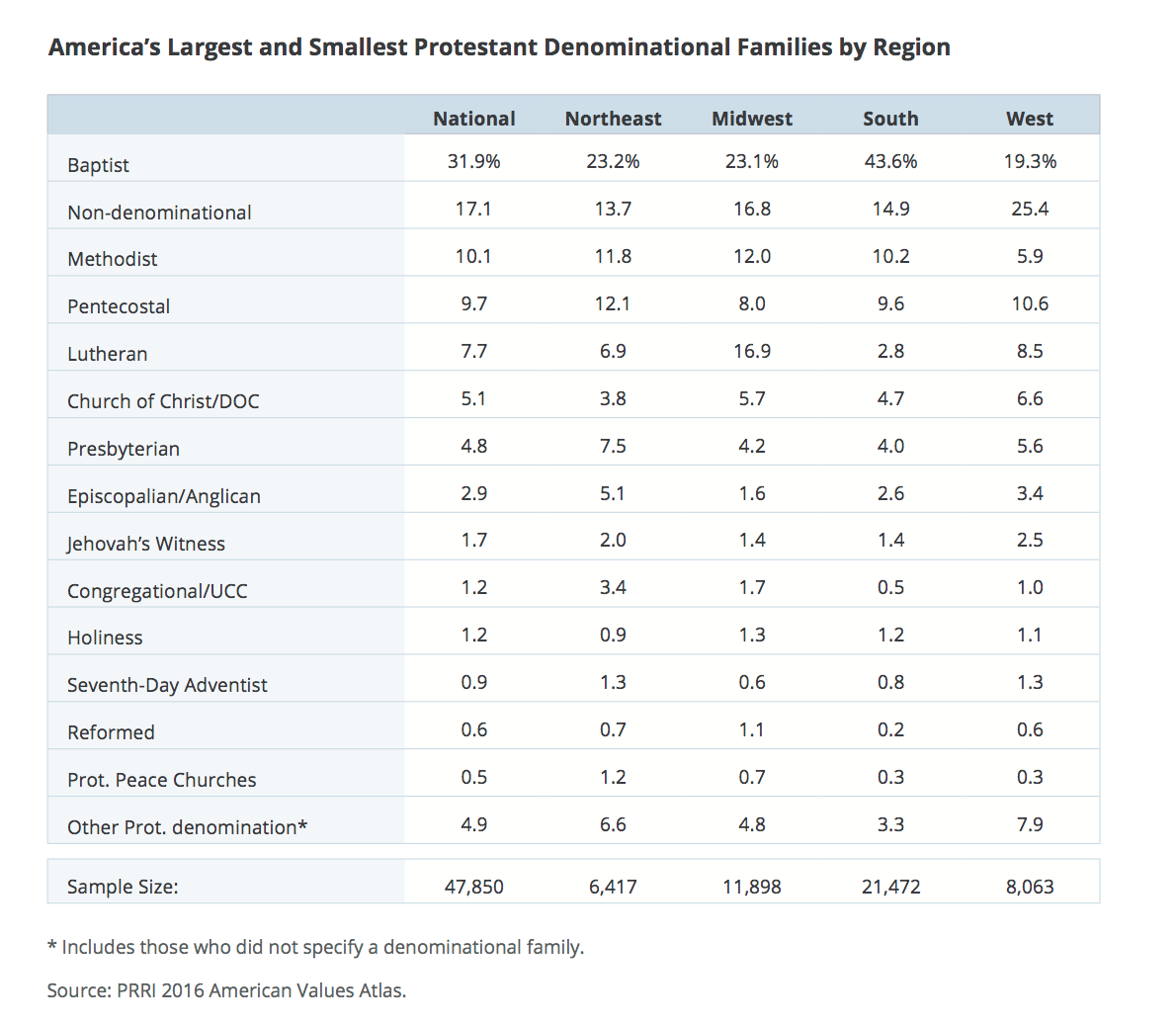
Certain states are likewise unique in that they are dominated past one denominational family. A majority of Protestants in Mississippi (60%), Arkansas (56%), Louisiana (55%), and Alabama (54%) are Baptist, while a majority of Protestants in Northward Dakota (56%) and nearly one-half of those in Minnesota (49%) are Lutheran.
Jewish Identity and Denominations
Overall, 1.five% of Americans identify as Jewish when responding to a question about their religious amalgamation. Nevertheless, previous research has suggested questions that frame Jewish identity in explicitly religious terms may undercount the total Jewish population considering they miss those with a cultural or familial analogousness. To address this issue, the survey included a question to identify those who had a cultural rather than a religious connection to their Jewish identity.3 An additional 0.eight% of Americans identify equally culturally but not religiously Jewish.
The issue of Jewish cultural identity has become increasingly important as younger Jews are more likely to have a cultural analogousness. Among Jews under the age of xxx, fewer than half (47%) identify as religiously Jewish, while a majority (53%) identify as culturally Jewish. In abrupt dissimilarity, more than than iii-quarters (78%) of Jewish seniors (age 65 or older) are religiously Jewish, while 22% place as culturally Jewish.
Among all Jewish Americans—those who place as Jewish both religiously and culturally—more identify as Reform than whatever other denomination. Twenty-eight percent of Jews identify equally Reform, compared to xiv% who identify as Conservative and 10% who identify as Orthodox. Two percent identify as Reconstructionist. Notably, more one-third (37%) of Jewish Americans claim to exist "just Jewish" when asked about their denominational affiliation. There is, yet, a considerable disparity in denominational membership among Jews past age.
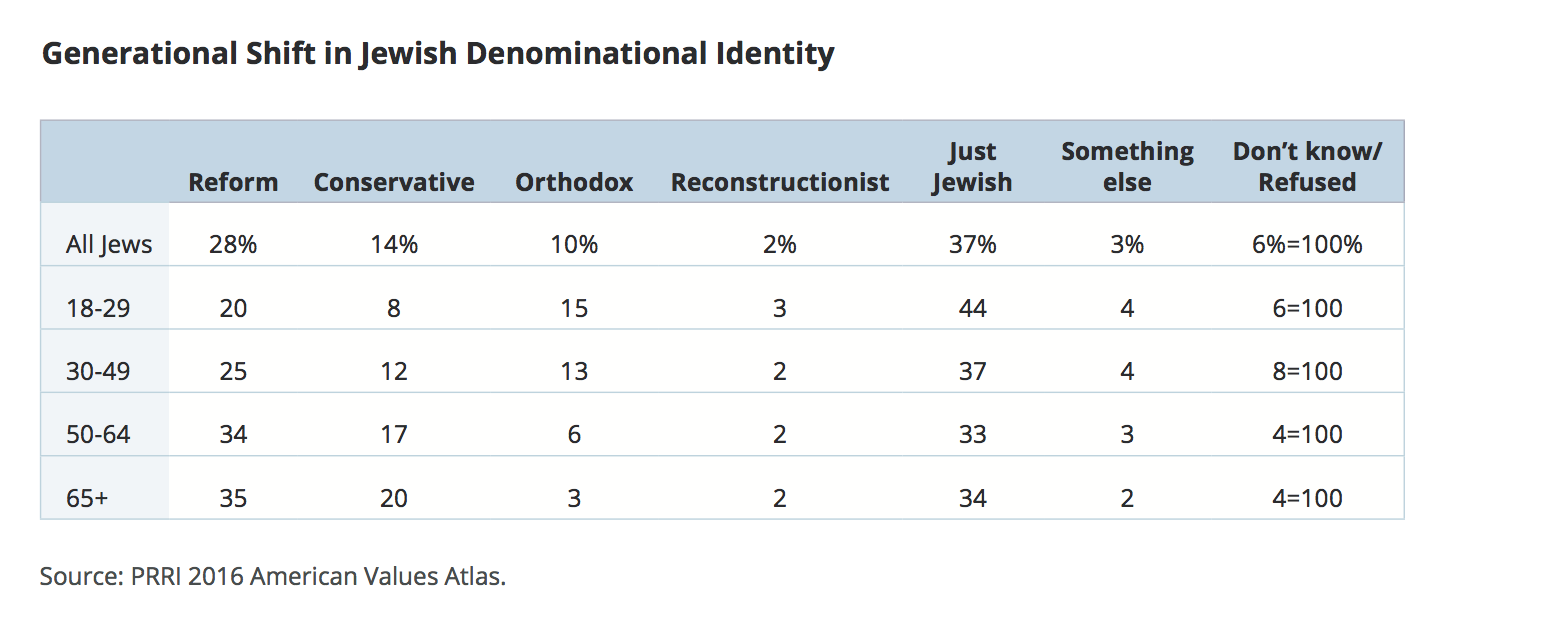
Only xx% of Jews under the age of 30 are Reform, compared to 15% who place as Orthodox. Fewer than i in 10 (8%) immature Jewish Americans affiliate with the Conservative movement, and iii percentage place equally Reconstructionist. More than four in ten (44%) say they are "only Jewish" in terms of their denominational affinity. Jewish seniors are nigh x times as likely to identify as Reform as they are to identify as Orthodox (35% vs. three%, respectively). One in five (20%) identify every bit Conservative, and ii percentage place as Reconstructionist. Approximately i-3rd (34%) do not claim any denominational affiliation.
Measuring Evangelical Protestant Identity
The size of the white evangelical Protestant population in the U.S. has often been misunderstood in contempo years. The primary source of confusion stems from researchers employing differing definitions of "evangelical" and their published findings often declining to conspicuously distinguish between the grouping as a whole and the distinct racial and ethnic subgroups within it. In this report, "evangelicals" are defined every bit those who self-place equally Protestant Christians who as well place equally evangelical or born over again.5
Self-identified evangelical Protestants business relationship for more 1-quarter (26%) of the public, but whites make upward only a subset of this larger group. Fewer than two-thirds (64%) of all evangelical Protestants are white. Nearly one in 5 (xix%) are black, one in ten (10%) are Hispanic, and half dozen per centum identify as some other race or mixed race.
Thus, among the public overall, white evangelical Protestants business relationship for fewer than ane in five (17%) Americans. V percentage of Americans are black evangelical Protestants, two percent are Hispanic evangelical Protestants, and other or mixed-race evangelical Protestants make up i pct of the public.
Like all Christians in the U.South., evangelical Protestants are experiencing a substantial racial and ethnic transformation. Young evangelical Protestants are far more racially and ethnically diverse than previous generations. Only one-half (50%) of evangelical Protestants under the age of 30 are white, compared to more than than iii-quarters (77%) of evangelical Protestant seniors (age 65 or older). Twenty-two percent of young evangelical Protestants are blackness, 18% are Hispanic, and nine percent identify as another race or mixed race.
III. America's New Religious Landscape: 3 Major Trends
The National Decline in White Christian Identity
Demographically, the U.S. historically has been an overwhelmingly white Christian country, with white Protestants lone constituting a clear cultural bulk.half dozen In 1976, roughly eight in ten (81%) Americans identified as white and identified with a Christian denomination. At that time, a majority (55%) of Americans were white Protestants.
Much of the refuse has occurred in the last few decades. As recently as 1996, white Christians still made upward nearly two-thirds (65%) of the public. By 2006, that number dropped to 54%, only white Christians still constituted a majority.eight But over the final decade, the proportion of white Christians in the U.S. has slipped below majority. Today, only 43% of Americans identify as white and Christian—and simply 30% equally white and Protestant.
Although white Christians have experienced substantial losses nationally, there are notable divisions in the size of the white Christian population past state. Today, united states with the highest concentrations of white Christians are more often than not found in the Midwest and Appalachia, including North Dakota (71%), South Dakota (68%), Iowa (64%), West Virginia (61%), Kentucky (61%), Utah (61%), Minnesota (59%), Missouri (58%), and Arkansas (58%). Conversely, white Christians are least plentiful in Hawaii (xx%), California (24%), New York (30%), New Mexico (30%), and Maryland (32%).
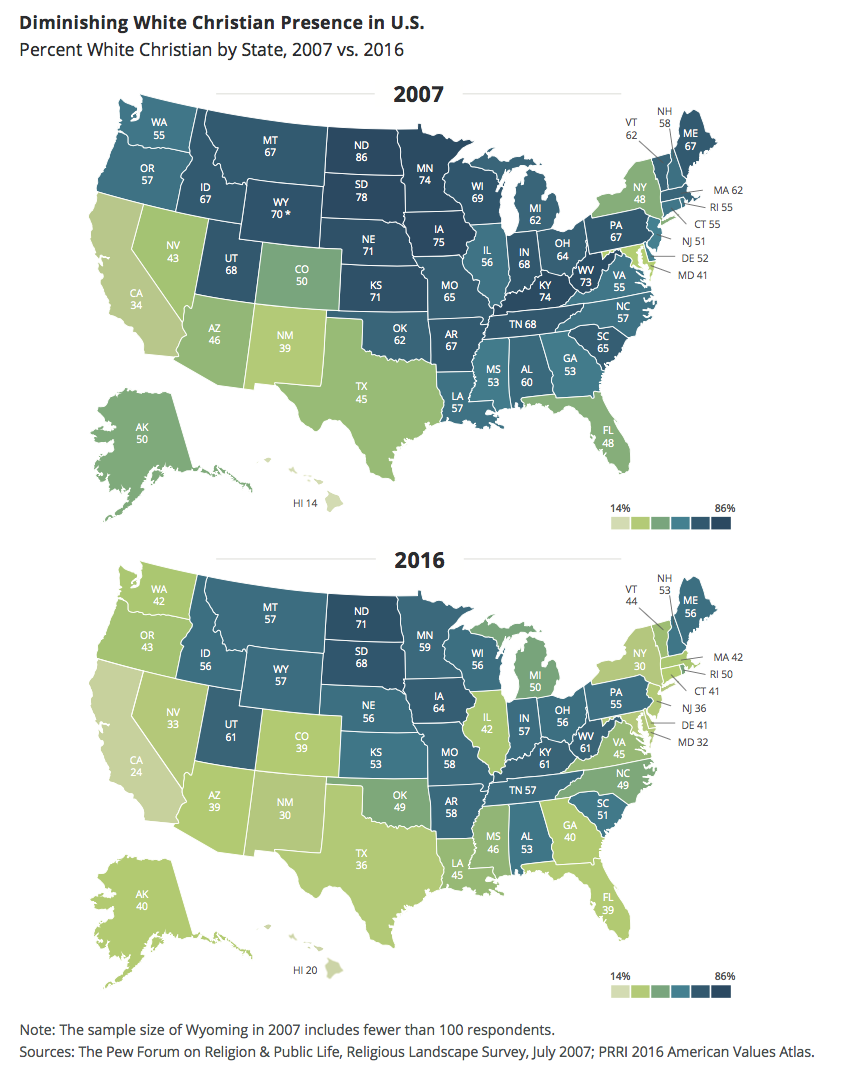
In total, fewer than half (23) of all 50 states accept majority white Christian populations. This represents a significant drop from 2007, when 39 states had majority white Christian populations.9
Notably, between 2007 and 2016, the proportions of white Christians have declined in every state but one (Hawaii), though the corporeality of decline varies widely by country. Many of us that experienced the greatest losses are full-bodied in the Northeast. Massachusetts, for example, experienced a xx-point reject in the number of white Christians living in the state over the last decade. Hawaii, the only state to experience an increase in the proportion of white Christians, saw an increment of six percentage points.
The Decline of White Evangelical Protestants
Although much of the research on religious refuse has focused on losses amid white mainline Protestants and white Catholics—groups with well-documented declines—much of the public discussion on religious change has missed one of the most of import stories of the last decade: The decline of white evangelical Protestants.10
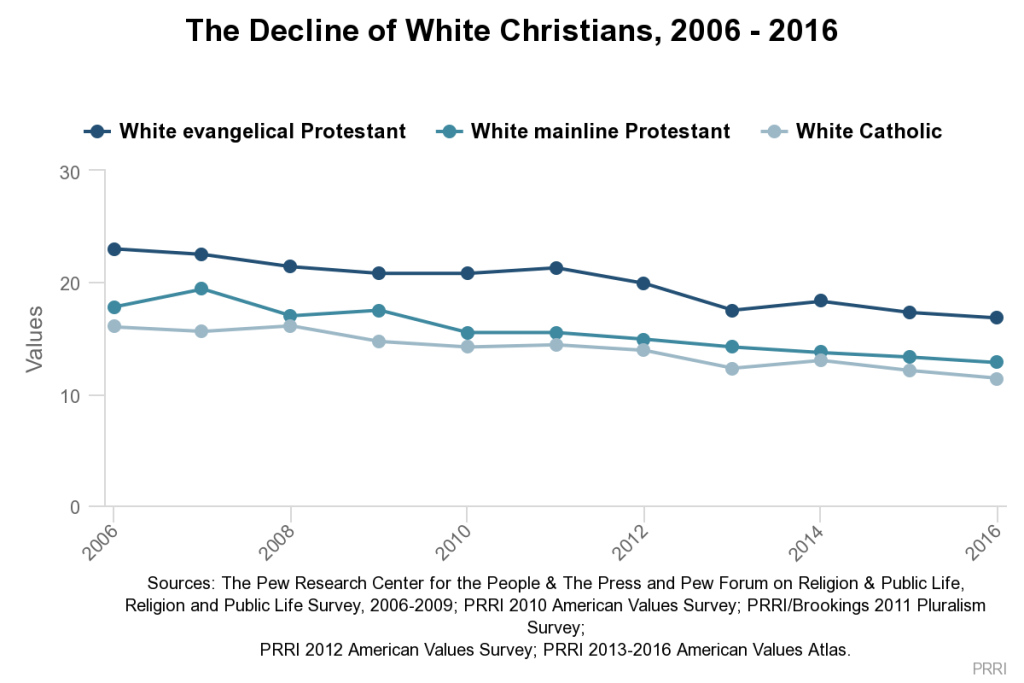 White evangelicals managed to avoid the start wave of white Christian decline in the 1990s and into the early years of the 21st century. Only between 2006 and 2016, the proportion of white evangelical Protestants has fallen six pct points, from 23% to 17%. White Catholics experienced a similar reject in membership, dropping five percent points from 16% in 2006 to 11% in 2016.eleven White mainline Protestants also experienced meaning losses during this catamenia, dropping from 18% in 2006 to 13% in 2016.
The Crumbling of White Christians
White Christians are not only declining, they are aging. Only slightly more than one in ten white evangelical Protestants (11%), white Catholics (11%), and white mainline Protestants (fourteen%) are under the age of thirty. Approximately six in ten white evangelical Protestants (62%), white Catholics (62%), and white mainline Protestants (59%) are at least 50 years old.
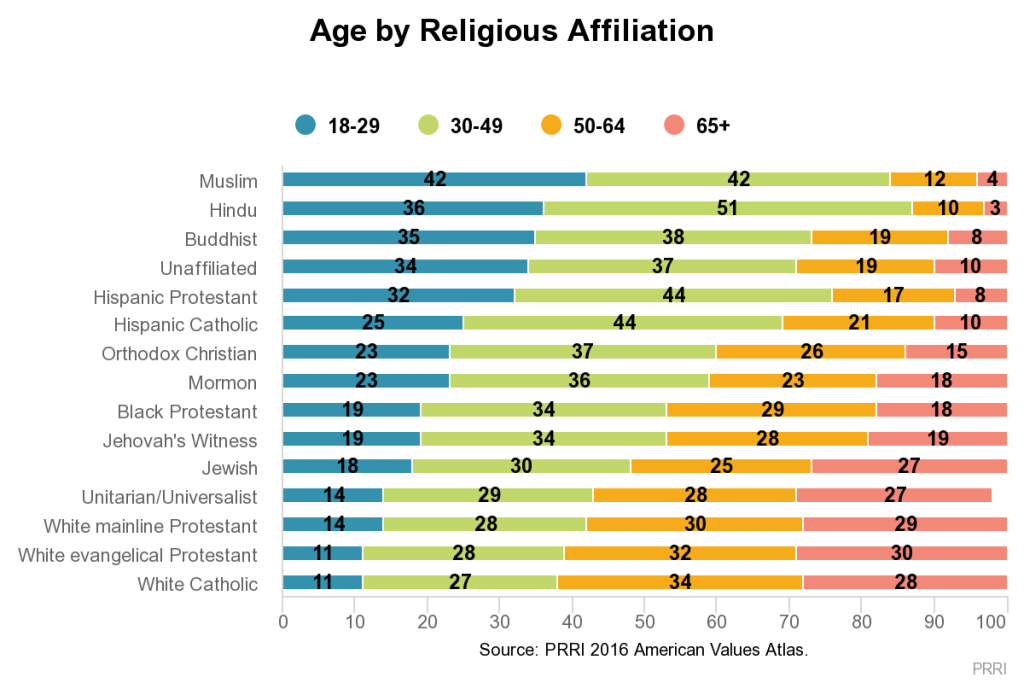 No religious group has older members than white evangelical Protestants and white Catholics. The median age of white evangelical Protestants and white Catholics is 55 years old, slightly higher than white mainline Protestants at 54 years one-time. Unitarian-Universalists are also much older than members of other religious groups: The median age is 54 years.
Four decades earlier, the median age of these white Christian groups was much lower. In 1976, the median age of white Catholics was but 40 years old, while the median age of white Protestants was 45 years old.12
In dissimilarity, nigh one in three Hispanic Protestants (32%), religiously unaffiliated Americans (34%), Buddhists (35%), and Hindus (36%) are nether the age of 30. More than four in ten (42%) Muslim Americans are under the age of 30. The median ages of Hindus (32 years), Muslims (32 years), Buddhists (36 years), religiously unaffiliated Americans (37 years), and Hispanic Protestants (37 years) are beneath 40.
The Mormon Exception
Although Mormons are a predominantly white Christian religious tradition, there is little show to suggest that they are experiencing similar declines.13 Currently, ane.9% of the public identifies every bit Mormon, a number identical to findings from a 2011 written report of Mormons in the U.Southward.14
Mormons are too much younger than other white Christian religious traditions. Well-nigh one-quarter (23%) of Mormons are under the age of 30. Fewer than one-half (41%) are age 50 or older.
The Growth of Nonwhite Christians
Increasing Racial and Indigenous Multifariousness Among Protestants
Today, 3 in ten (30%) Americans are white Protestant. This is a considerable decline over the past couple of decades; in 1991, white Protestants represented half (50%) the public.fifteen Not merely have white Protestants experienced a substantial decline as a proportion of the general population, they also represent a shrinking proportion of all Protestants. In 1991, 83% of all Protestants were white, compared to two-thirds (67%) today. Ane-third (33%) of all Protestants are now nonwhite.
Notwithstanding, the caste of racial and ethnic diversity among Protestants varies considerably between denominational families. More than than nine in ten Lutherans (92%) and roughly 8 in x Methodists (83%), Presbyterians (83%), and Episcopalians (80%) are white, not-Hispanic. In contrast, fewer than 6 in ten (58%) Baptists are white, and a sizeable share of members are black (30%) or Hispanic (5%). Similarly, simply half (fifty%) of Pentecostals are white, while one-quarter (25%) are Hispanic, and 17% are black. Protestants who belong to not-denominational Protestant churches are also somewhat various: Ii-thirds (67%) are white, 13% are black, and 10% are Hispanic.
The Ethnic Transformation of the U.S. Catholic Church
For most of the past 25 years, American Catholics have been overwhelmingly white. In 1991, more than viii in x (87%) U.Due south. Catholics were white, non-Hispanic.xvi Today, 55% of Catholics place equally white, non-Hispanic, and more than 1-third (36%) are Hispanic. Notably, much of the shift in the ethnic composition of the American Catholic customs occurred over just the concluding couple of decades.
Generational differences in the indigenous and racial make-up of American Catholics as well suggest that a substantial cultural shift is underway. Fewer than four in ten (36%) Catholics under the age of 30 are white, non-Hispanic, compared to a majority (52%) who are Hispanic. In contrast, more than three-quarters (76%) of Catholic seniors (historic period 65 or older) are white, while only 17% are Hispanic.
Demographic differences between Hispanic and white Catholics likewise advise that the Hispanic Catholic community is poised to make further gains. Beginning, Hispanic Catholics are nearly twice as likely as white Catholics to be parents of children under the age of xviii (30% vs. sixteen%, respectively). The discrepancy in parental status is driven largely by age differences between Hispanic Catholics and white Catholics. Second, Hispanic Catholics are more likely to have larger families: Close to three in ten (28%) Hispanic Cosmic parents have at to the lowest degree iii children under the age of xviii living at home, while 21% of white Catholic families report the same.
The Shifting Cultural Center of the Catholic Church
Historically, the U.S. Catholic Church was centered in the Northeast, where European immigrants from predominantly Catholic countries, such every bit Italy and Ireland, first settled. Fifty-fifty today, Catholics represent a asymmetric size of the population in many states in the region, including Rhode Isle (41%), Massachusetts (34%), New Jersey (34%), Connecticut (31%), and New York (31%).
Even so, due to recent patterns of clearing from predominantly Catholic countries in Latin America, particularly Mexico, the Catholic population is experiencing growth across the Southwest. In 1972, roughly seven in x Catholics lived in either the Northeast (41%) or the Midwest (28%).17 Only about one-3rd of Catholics lived in the S (13%) or W (18%). Today, a bulk of Catholics now reside in the South (29%) or West (25%). Currently, but about 1-quarter (26%) of the U.S. Catholic population lives in the Northeast.
Regional historic period differences among Catholics also indicate that Catholicism's heart of gravity is shifting. American Catholics residing in the Northeast and Midwest are essentially older than Catholics in the Southwestern Us. Fewer than half of Catholics in the Northeast (47%) and Midwest (44%) are less than 50 years of age. In dissimilarity, a majority (58%) of Catholics living in the Western U.South. are under the age of 50.
Rising of the Religiously Unaffiliated
The religiously unaffiliated—those who place every bit "atheist," "agnostic," or "nothing in particular"—now account for well-nigh one-quarter (24%) of Americans. Since the early 1990s, this group has roughly tripled in size.
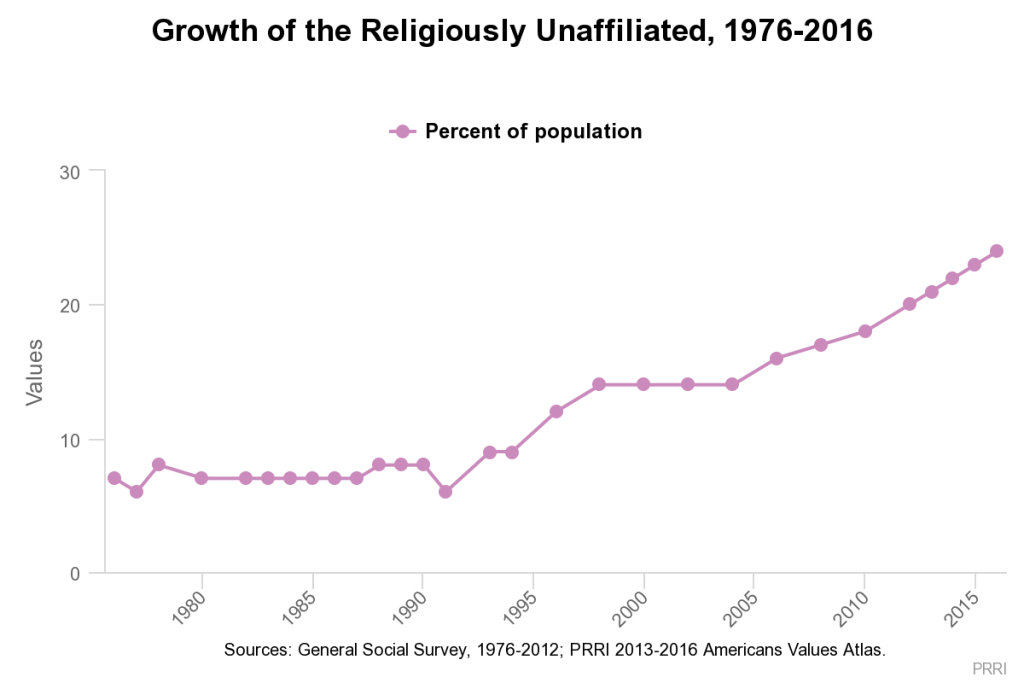 Religious identity is highly stratified by age, with younger Americans (age 18-29) most probable to exist religiously unaffiliated and seniors (age 65 or older) least likely to identify this mode. Even so, the human relationship between historic period and unaffiliated condition is not completely linear. While there is considerable variation at the youngest and oldest ends of the historic period spectrum, there is less variation in the rate of unaffiliated identity among Americans in their 40s (23%), 50s (eighteen%), and 60s (sixteen%).
Although unaffiliated Americans tend to be younger than religiously affiliated Americans on boilerplate, the grouping collectively is older today than it was a generation ago. Today, about one-third (34%) of unaffiliated Americans are under the historic period of 30, while nearly three in ten (29%) are at least 50 years old. In the 1970s, half (50%) of all unaffiliated Americans were under 30 years old, and only 17% were age fifty or older. The median historic period of someone who was unaffiliated during that decade was also 7 years younger than it is today: 29 vs. 36, respectively.
Atheists, Agnostics, Seculars, and the Religiously Unattached
There are notable differences amidst the unaffiliated in terms of their religious identity. Simply about i-quarter of the unaffiliated identify as atheist (14%) or doubter (xiii%), while fewer than one in five (16%) identifies as a "religious person." The majority (58%) of Americans who arenot religiously affiliated do not identify equally a religious person.xviii
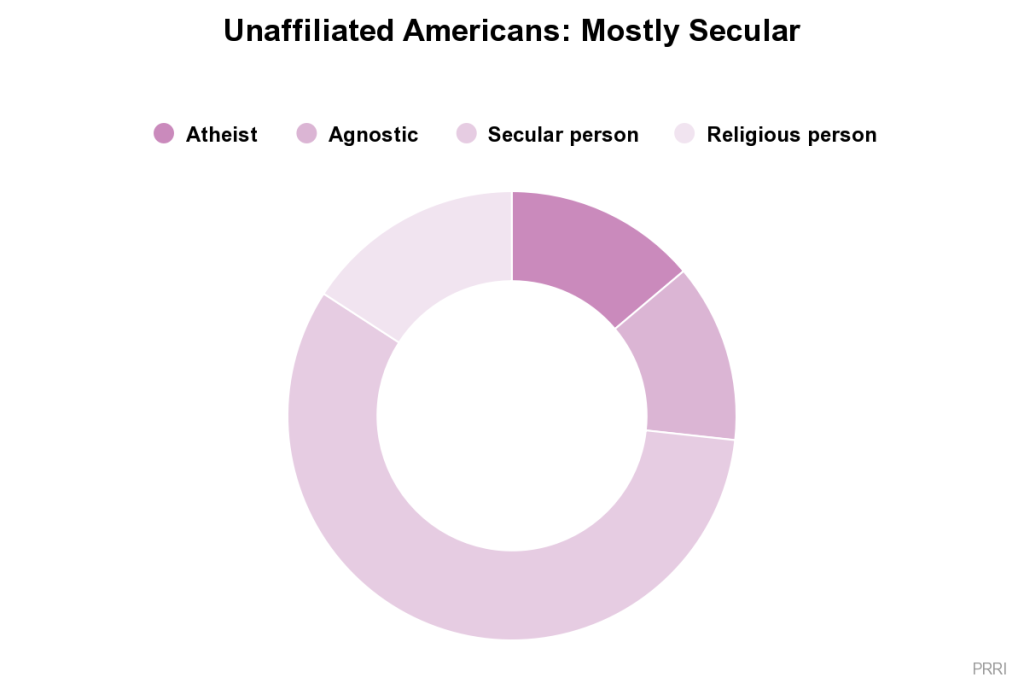 Younger unaffiliated Americans are merely somewhat more likely than unaffiliated seniors to identify equally atheist or agnostic (31% vs. 24%, respectively), while unaffiliated seniors are twice as probable as younger unaffiliated Americans to identify as a religious person (20% vs. 10%, respectively). A majority of unaffiliated immature adults and seniors say they are secular (59% vs. 56%, respectively).
IV. Demographic Comparisons of Major Religious Groups
The Enduring Gender Carve up
Women keep to make up the majority of most religious groups—including most Christian groups. A majority of black Protestants (58%), white evangelical Protestants (56%), Hispanic Catholics (55%), white mainline Protestants (54%), white Catholics (53%), and Hispanic Protestants (53%) are women.
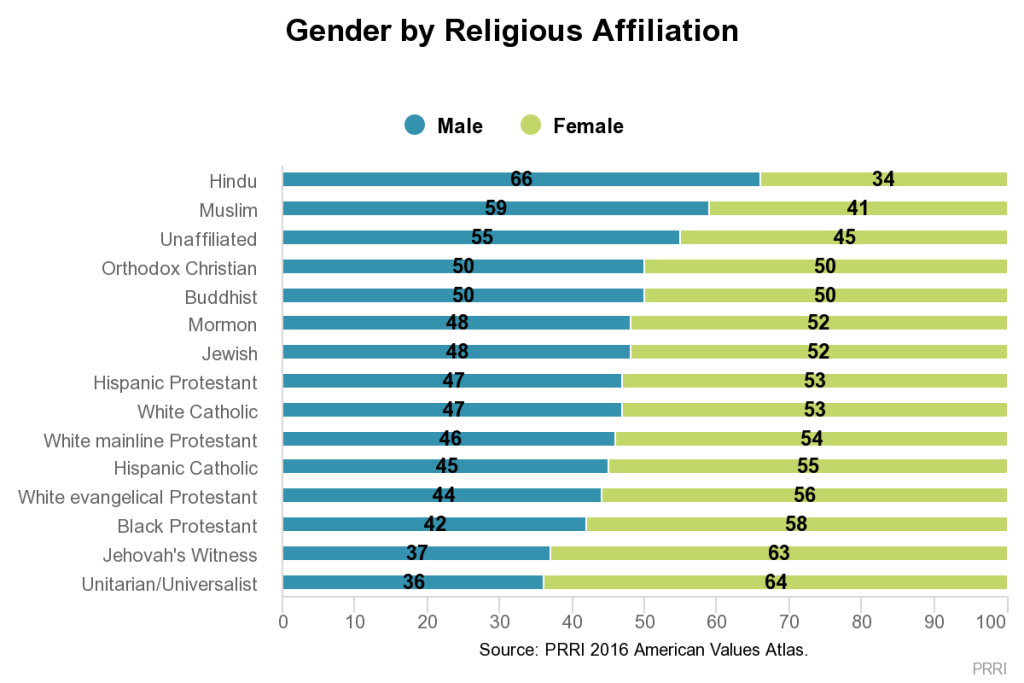 Among Mormons and Jewish Americans, the gender split mirrors that of the general public—48% male, 52% female person—while the gender carve up among Buddhists and Orthodox Christians is exactly fifty-fifty (fifty% male, 50% female).
Men brand upward a majority of religiously unaffiliated Americans (55%), Muslims (59%), and Hindus (66%). Fewer than half of unaffiliated Americans (45%), Muslims (41%), and Hindus (34%) are women. Atheists and agnostics are more heavily male-dominated than the unaffiliated overall: Men account for 64% of atheists and 63% of agnostics.
The gender imbalance is too quite prominent amongst Unitarian Universalists, amidst whom nearly two-thirds (64%) are women. Only 36% are men.
Educational Attainment
Levels of educational attainment vary widely betwixt religious groups, fifty-fifty among white Christians. Unitarian-Universalists and Hindus are, on average, the well-nigh educated, while Hispanic Catholics are the least formally educated.
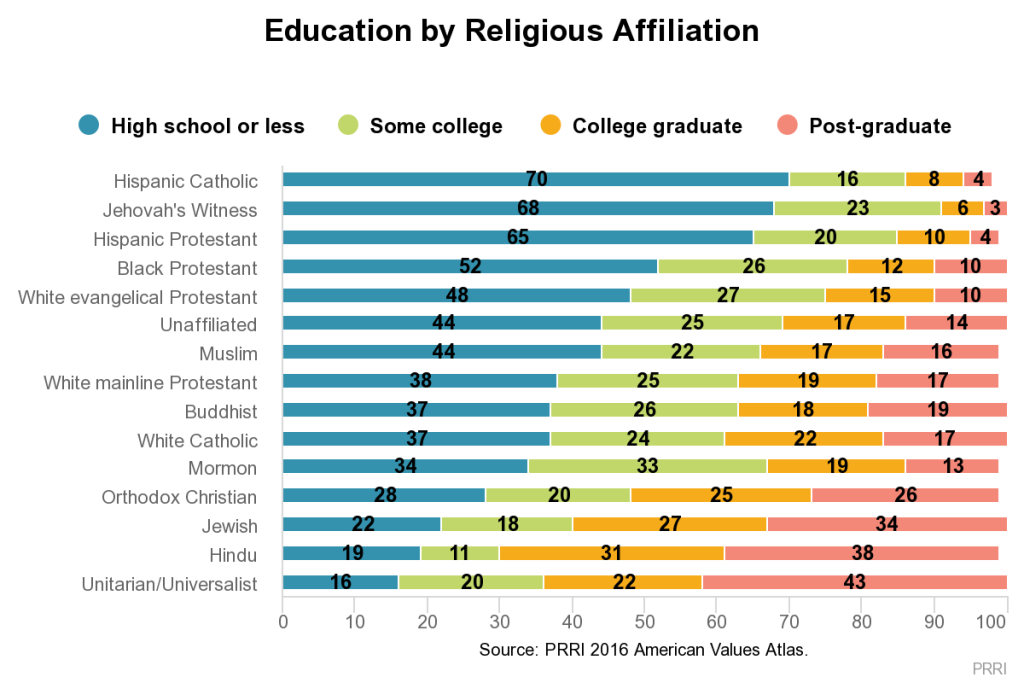 Close to half (48%) of white evangelical Protestants have a high school education or less, compared to fewer than four in ten white mainline Protestants (38%), white Catholics (37%), and Mormons (34%). Roughly i-third of Mormons (32%) and more than than i-third of white mainline Protestants (36%) and white Catholics (39%) take a four-yr higher caste, compared to just one-quarter (25%) of white evangelical Protestants.
Amidst Protestants, at that place are substantial variations past denominational family. Presbyterians and Episcopalians have the highest levels of educational attainment. Roughly half of Presbyterians (48%) and Episcopalians (52%) take at least a four-year college degree. In contrast, significantly fewer Methodists (36%), Lutherans (34%), Baptists (19%), and Pentecostals (15%) graduated from a iv-year college or academy. A majority (55%) of Baptists and half dozen in ten (60%) Pentecostals have no more than a loftier school education.
Nearly half (49%) of Catholics have a loftier school education or less, while more than ane in five (21%) have some college education, and 29% report having at least a iv-year college degree. Withal, levels of educational attainment vary considerably by ethnicity. Seven in ten (seventy%) Hispanic Catholics have a high school education or less, compared to 37% of white Catholics. White Catholics are about three times every bit likely as Hispanic Catholics to have at least a four-twelvemonth higher degree (39% vs. 12%, respectively).
Nonwhite Christian religious groups have considerably lower levels of education. A majority of black Protestants (52%), Hispanic Protestants (65%), and Hispanic Catholics (70%) report having a high school pedagogy or less. Fewer than 1-quarter of black Protestants (22%), Hispanic Protestants (14%), and Hispanic Catholics (12%) take a college degree.
Among non-Christian religious groups, Muslims accept the lowest levels of educational attainment. More iv in ten (44%) Muslims have a high school caste or less, compared to 37% of Buddhists and about i in five Jews (22%) and Hindus (xix%). Jewish and Hindu Americans are highly educated; strong majorities have a iv-year college degree (61% vs. 69%, respectively), including more than one-3rd of each group who accept post-graduate degrees (34% vs. 38% respectively).
However, among Jewish Americans, there are considerable differences in educational groundwork by denomination. Orthodox Jews are far more than probable than Reform Jews to accept no more a high school education (44% vs. 14%, respectively).
No religious group has a higher proportion of members with postal service-graduate degrees than Unitarian-Universalists. Well-nigh 2-thirds (65%) accept a college education, including more iv in ten (43%) who take an avant-garde degree.
Religiously unaffiliated Americans are less educated than many religious groups. More than than four in ten (44%) accept a high schoolhouse education or less. Ane-quarter (25%) accept some college feel, such as an associate's degree, and roughly three in ten (31%) have a 4-yr higher education. Yet, self-identified atheists and agnostics have significantly greater educational experience. About i-third of atheists (34%) and agnostics (31%) accept no more a loftier school teaching, while 42% of each grouping have at least a iv-year college degree.
Economical Condition
Household income
Religious groups with the lowest levels of household incomes tend be Christians from racial and ethnic minority groups. More than iv in x black Protestants (43%), Hispanic Protestants (45%), Jehovah'southward Witnesses (45%), and Hispanic Catholics (49%) written report household earnings of less than $30,000 per year.
White Christian groups report higher levels of income. Fewer than 1-third of white evangelical Protestants (28%), Mormons (26%), white mainline Protestants (22%), and white Catholics (xix%) have household incomes of less than $30,000 per year.
Amidst non-Christian groups, Muslims report the everyman levels of household income. Almost four in x (38%) Muslims take household incomes of less than $xxx,000 per twelvemonth, compared to fewer than ane-tertiary of Buddhists (31%), Hindus (20%), and Jews (xvi%). 1-quarter (25%) of Hindus and 30% of Jewish Americans have annual household incomes in excess of $100,000. Unitarians-Universalists are also fairly well off financially. Only 18% report living in households making less than $30,000 annually, and 22% report having incomes exceeding $100,000.
The income levels of religiously unaffiliated Americans closely mirror Americans overall.
Habitation Ownership
Patterns of homeownership vary considerably among religious groups. Roughly three-quarters of white Catholics (78%), white evangelical Protestants (75%), and white mainline Protestants (75%) report they own their home. About two-thirds (66%) of Mormons say they own rather than hire.
Nonwhite Christians are far less likely to report owning their abode. Fewer than half of Jehovah's Witnesses (48%), black Protestants (46%), Hispanic Catholics (38%), and Hispanic Protestants (38%) are homeowners.
Among non-Christian groups, Jewish Americans (69%) are much more likely than Buddhists (54%), Muslims (36%), or Hindus (31%) to own their abode. More than seven in ten (72%) Unitarian-Universalists own their home. A majority (54%) of religiously unaffiliated Americans are homeowners.
Health Insurance Condition
A slim majority (51%) of white Catholics and close to half of Mormons (48%) and white mainline Protestants (46%) report they receive health insurance through their employer. More 4 in ten (43%) white evangelical Protestants say they have employer-based wellness insurance. Three in ten (30%) white evangelical Protestants take government-sponsored health intendance such as Medicare or Medicaid, while fewer white mainline Protestants (27%), white Catholics (25%), and Mormons (22%) report the same.
Nonwhite Christians are much less probable to have employer-based health insurance than white Christians, simply there are notable differences in patterns of coverage among these groups. Nearly i-third of black Protestants (35%), Hispanic Protestants (31%), Jehovah's Witnesses (31%), and Hispanic Catholics (29%) report having health insurance through their employer. Jehovah's Witnesses (33%) and black Protestants (30%) are more likely to receive wellness insurance through regime programs than Hispanic Protestants (21%) and Hispanic Catholics (23%). But well-nigh one-3rd of Hispanic Protestants (29%) and Hispanic Catholics (32%) report they accept no health insurance coverage at all.
No grouping is more likely to receive health insurance through their employer than Hindus. More than half-dozen in 10 (62%) Hindus have employer-sponsored wellness intendance coverage. Fewer than half (47%) of Jewish Americans, 4 in ten (40%) Buddhists, and nigh 3 in ten (29%) Muslims receive health insurance through an employer. Hindus are also far less probable to receive wellness care through government programs, such as Medicare or Medicaid, with merely six percent reporting they receive this blazon of coverage. In dissimilarity, at least ane in five Buddhists (21%), Muslims (25%), and Jews (25%) have government-sponsored health insurance. Nearly one in five (nineteen%) Muslims report having no health insurance coverage.
The health care insurance status of religiously unaffiliated Americans closely resembles that of Americans overall. Iv in ten (43%) receive it through an employer, while 19% report receiving it through the government. Fifteen percent have no health insurance.
Approximately four in ten (43%) Unitarian-Universalists also receive their wellness insurance through an employer, while shut to one-third (29%) accept government-sponsored coverage. Only four percent of Unitarian-Universalists study having no health insurance at all.
Race and Ethnicity
The patterns of religious identity amidst major racial and ethnic groups are quite singled-out. Nearly vii in 10 (68%) white Americans are Christian and nigh one-half (47%) are Protestant. Twenty-seven percent of whites are evangelical Protestant, while 20% are mainline Protestant. An additional xviii% of whites are Cosmic. One-quarter (25%) of all whites are religiously unaffiliated.
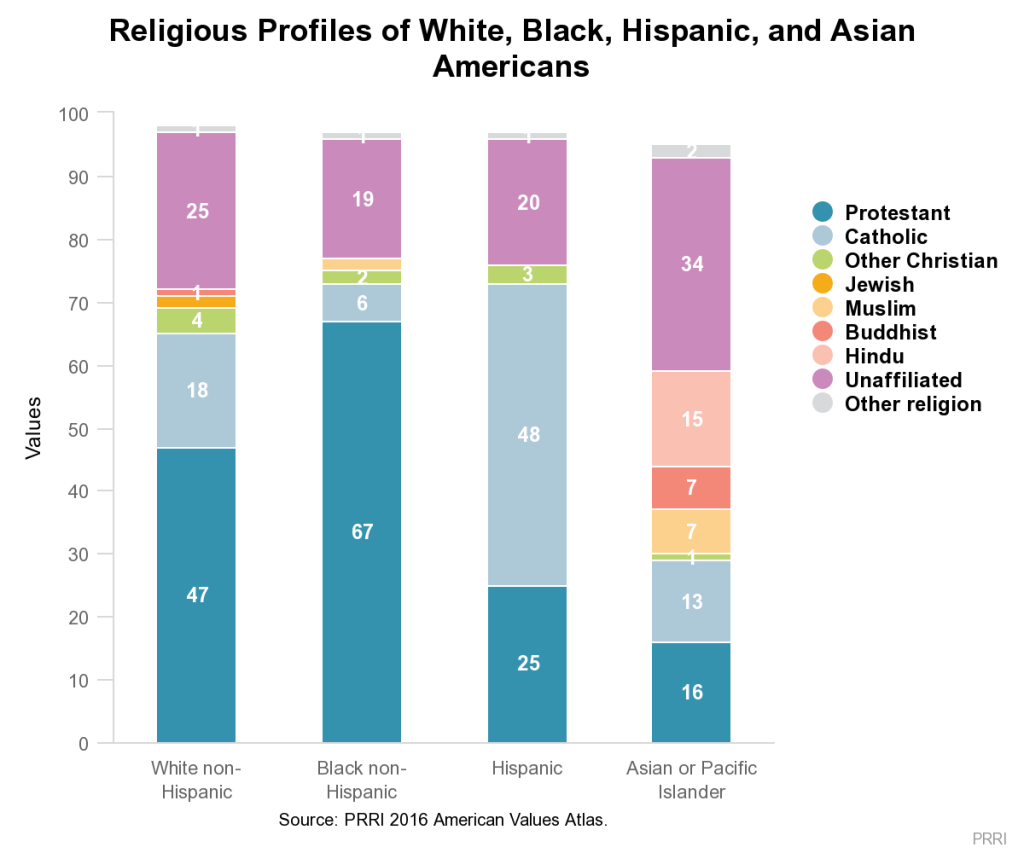 Black Americans are also predominantly Christian. Three-quarters (75%) of black Americans are Christian, although a much greater proportion are Protestant (67%), and simply six percent identify as Catholic. Roughly one in five (19%) black Americans are religiously unaffiliated. Hispanic Americans are also predominantly Christian, although they are about twice as likely to identify as Cosmic (48%) than Protestant (25%). One in five (20%) Hispanics are unaffiliated.
Dissimilar other racial and ethnic groups, fewer than 1 in three (30%) Asian and Pacific Islander (API) Americans are Christian, with roughly equal numbers identifying as Protestant (16%) and Catholic (13%). More than than one-tertiary (34%) of API Americans are religiously unaffiliated, with significant numbers identifying as members of non-Christian traditions, such as Hindu (xv%), Buddhist (7%), or Muslim (7%).
Marital Status and Family Size
Divisions in marital condition among American religious communities largely occur along racial lines. At to the lowest degree six in ten white mainline Protestants (60%), white Catholics (61%), white evangelical Protestants (64%), and Mormons (68%) are married. In contrast, members of nonwhite religious traditions are much less likely to exist married. Only 37% of black Protestants, 45% of Hispanic Protestants, and half (50%) of Hispanic Catholics report being married.
Notably, among non-Christian groups, Hindus (66%) are far more likely than Muslims (49%) and Buddhists (35%) to exist married. More half dozen in ten (62%) Jewish Americans too study beingness married, although there are some differences by denomination. Nearly iii-quarters (74%) of Orthodox Jews are married, compared to about six in ten who vest to Conservative (64%) and Reform (59%) denominations. Roughly four in ten (42%) religiously unaffiliated Americans are married.
White Christians stand out in that they do not take young children living at domicile. Well-nigh 3-quarters of white evangelical Protestants (73%), white mainline Protestants (73%), and white Catholics (75%) practice non take children under the age of 18 living at home. Roughly seven in 10 Jews (71%) and Buddhists (72%), and approximately two-thirds of religiously unaffiliated Americans (68%), black Protestants (67%), and Hindus (67%), besides report that they have no children living in their household. In contrast, merely about half (50%) of Hispanic Catholics and Hispanic Protestants (52%) take no children in their households.
Amongst Americans who report living with children in their household, Mormons have by far the largest families. More than than 4 in ten (42%) Mormon parents say they have at least 3 children in their household nether the age of 18. Only 28% of Mormons living with children report having simply one kid. By comparison, fewer than one-quarter of white evangelical Protestants (24%), white mainline Protestants (23%), and white Catholics (21%) with children say they accept at least three kids in their household.
Most three in x (29%) Jewish parents report having at least three children in their household, although family size varies dramatically by denomination. More than six in ten (62%) Orthodox Jewish parents say they accept at least three children living in their household, compared to 17% of Jewish parents who identify every bit Reform who say the same.
Hindus take some of the smallest families. A majority (55%) of Hindus with children say they have just one child in their household, while just iv percent say they have iii or more. Muslim families are larger, with more i-quarter (26%) of those with children in their household reporting three or more.
The Religious Identity of LGBT Americans
LGBT Americans are far less likely to identify with any religious group than the public as a whole. Nearly half (46%) of Americans who identify every bit lesbian, gay, bisexual, or transgender (LGBT) are religiously unaffiliated. Fewer identify as Christian. Simply six percent of LGBT Americans are white evangelical Protestant, while similar numbers identify every bit white mainline Protestant (8%) and white Catholic (6%). Fewer than one in ten identify as black Protestant (vi%), Hispanic Catholic (5%), or Hispanic Protestant (3%). LGBT Americans are somewhat overrepresented amongst not-Christian religions. Six per centum identify as Jewish (2%), Buddhist (2%), Muslim (one%), or Hindu (ane%).
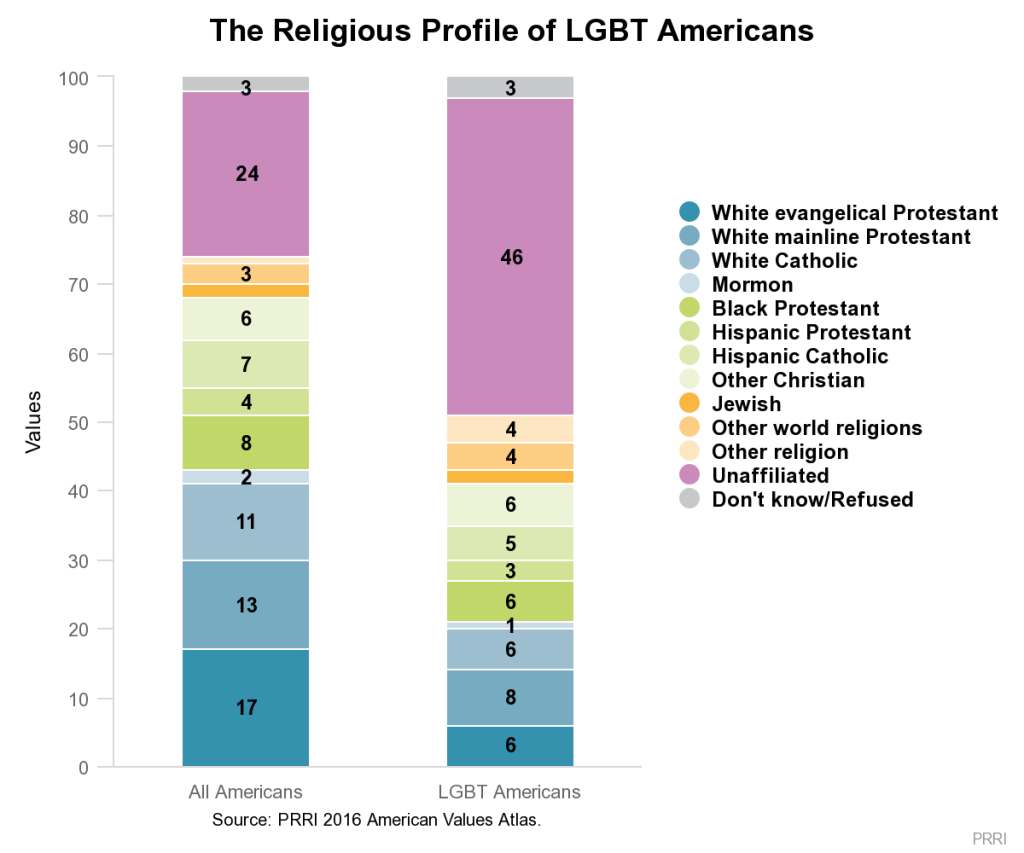
There are stark generational differences among LGBT Americans in their religious identity. A majority (56%) of LGBT young adults (age 18 to 29) are religiously unaffiliated, compared to one-quarter (25%) of LGBT seniors (age 65 or older). In that location are no meaning gender differences in the religious profile of LGBT people.
Notably, Buddhists and Unitarian-Universalists have a much college proportion of LGBT members than other religious traditions. I in seven Buddhists (14%) and Unitarian-Universalists (xiv%) identify as LGBT.
V. Religion and Politics
Political Amalgamation
No religious group is more closely tied to the Republican Party than white evangelical Protestants. Nigh half (49%) of white evangelical Protestants identify as Republican, virtually one-third (31%) are independent, and just fourteen% are Autonomous. Mormons also lean heavily Republican, with more than than four in ten (44%) identifying with the GOP, compared to 12% who are Democrats. White mainline Protestants (34% Republican, 26% Democrat) and white Catholics (34% Republican, 26% Democrat) also lean more than toward the Republican Party.
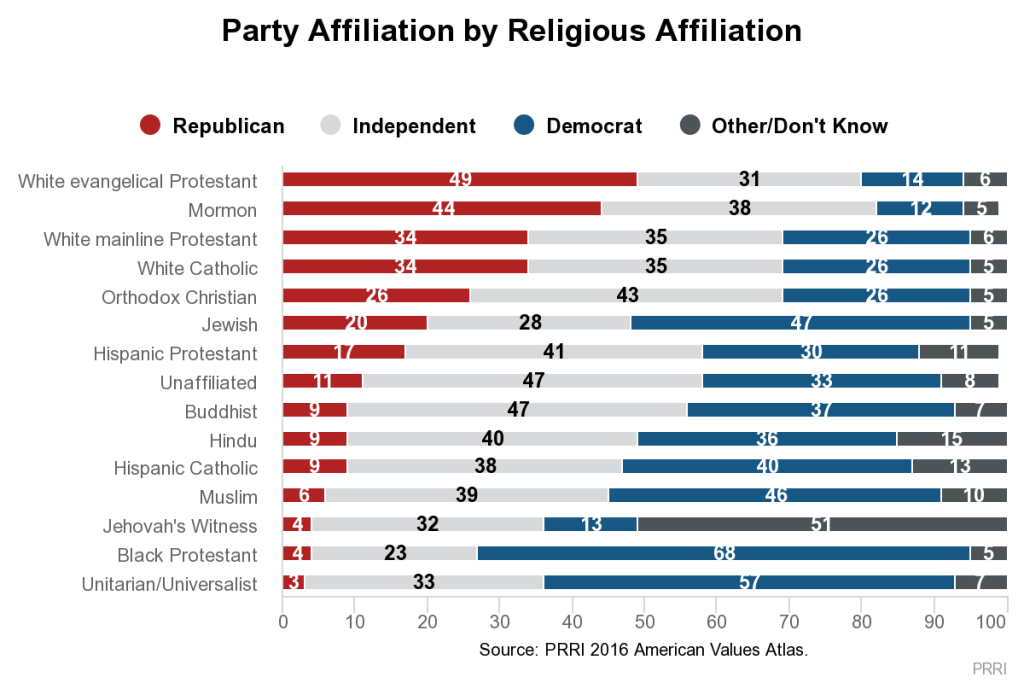 Notably, older white Christians are by and large more likely to be affiliated with the Democratic Party than those who are younger. White evangelical Protestant seniors are about twice as likely every bit those under the age of 30 to identify as Democrat (xviii% vs. 10%, respectively); they are about equally as likely to identify equally Republican (49% vs. 47%, respectively). Similarly, while nearly one-tertiary (31%) of white Catholic seniors are Democrats, only most one in five (21%) white Catholic immature adults identify as the aforementioned. The generational gap is slightly smaller among white mainline Protestants: Twenty-eight percent of seniors, compared to 21% of young adults, are affiliated with the Democratic Political party.
Nonwhite Christians tend to lean more toward the Autonomous Party, although there is pregnant diverseness in the partisan preferences of these groups. No religious group more than strongly identifies with the Democratic Party than black Protestants. More than than ii-thirds (68%) of black Protestants identify as Democrats, compared to only four percent who identify as Republican. Hispanic Catholics are more than than four times as probable to identify as Democrat than they are to identify equally Republican (40% vs. ix%, respectively). Hispanic Protestants also lean Democratic in their political preferences, although past a more than small-scale margin (xxx% vs. 17%, respectively). More than four in ten (41%) Hispanic Protestants are independent.
Chiefly, in that location are substantial generational differences in partisan identity among black Protestants and Hispanic Catholics. Black Protestant seniors are far more probable to identify as Democratic than young black Protestants (79% vs. 58%, respectively). A majority (56%) of Hispanic Catholic seniors identify as Autonomous, while merely near ane-3rd (35%) of immature Hispanic Catholics identify as the aforementioned.
The pattern of partisan attachment is also lopsided in favor of Democratic identity amongst non-Christian religious groups. Near one-half of Jewish (47%) and Muslim Americans (46%) identify as Democratic, while far fewer identify equally Republican (twenty% vs. 6%, respectively). Buddhists (37% Democrat, 9% Republican) and Hindus (36% Democrat, ix% Republican) also bear witness far more analogousness for the Autonomous Political party. However, four in ten (forty%) Hindus and nearly half (47%) of Buddhists are contained.
Among Jewish Americans, partisan attachments vary considerably by denominational affiliation. Roughly six in ten (59%) Reform Jews and 47% of Bourgeois Jews place as Democrats, compared to only 23% of Orthodox Jews. Almost 4 in ten (38%) Orthodox Jews identify as Republican, and 29% identify every bit contained.
Religiously unaffiliated Americans are also more likely to identify as independent (47%) than they are to identify as Democratic (33%) or Republican (11%) combined. Amidst religiously unaffiliated subgroups, atheists are more Democratic leaning, with more than four in 10 (44%) identifying as Democrat.
No religious group is less likely to place as Republican than Unitarian-Universalists. Only 3 percent of Unitarian-Universalists are Republican. A bulk (57%) place as Democrat, and one-third (33%) are contained. As well notable are the unique profile of Jehovah'due south Witnesses. Reflecting their historical theological commitment to political neutrality, more than than half (51%) of Jehovah'due south Witnesses either refused to reply the question about partisan identity or responded by saying they didn't know.
Shifting Religious Coalitions of Autonomous and Republican Parties
The religious coalitions of the Autonomous and Republican Parties are drifting further apart. In 2006, more than viii in x (81%) Republicans identified as white Christian, including white evangelical Protestant (37%), white mainline Protestant (22%), and white Catholic (20%). Half (50%) of the members of the Democratic Party also identified as white Christian, including white evangelical Protestant (17%), white mainline Protestant (16%), or white Catholic (16%). Today, roughly three-quarters (73%) of the Republican Party is white Christian, only fewer than 1-third (29%) of the Democratic Political party identifies this way.
However, both political parties are being impacted by the larger tectonic changes in the religious landscape. These changes can exist seen clearly in the generational profiles within each party.
More than than eight in ten (84%) Republican seniors (age 65 or older) identify as white Christian, including 42% who are white evangelical Protestant. Significantly fewer (57%) young Republicans (age 18-29) are white Christian, and only about ane-quarter (24%) are white evangelical Protestant. Young Republicans are as well three times more than likely than seniors to exist religiously unaffiliated (19% vs. 6%, respectively).
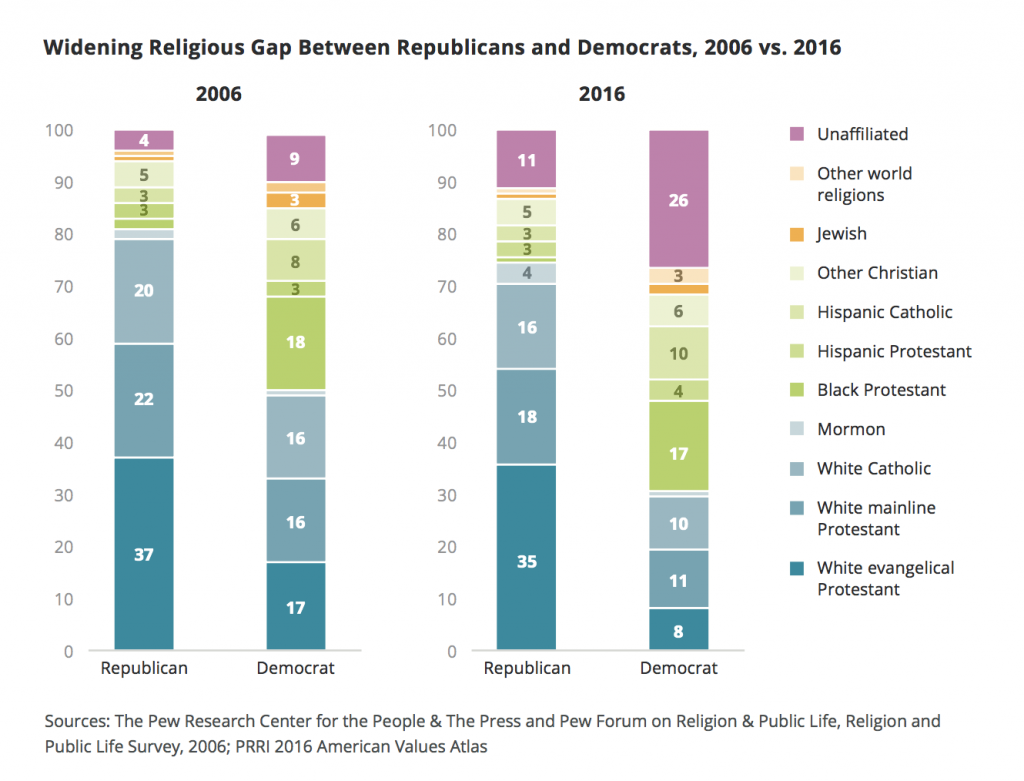
The Democratic coalition is also shedding white Christian members, who are fast becoming a minor constituency within the party. Among Democratic seniors, close to half identify as white Christian, including white evangelical Protestants (fifteen%), white mainline Protestants (17%), or white Catholics (fifteen%). Simply xv% of Autonomous seniors are religiously unaffiliated. By dissimilarity, white Christians make up only 14% of immature Democrats, including white evangelical Protestants (3%), white mainline Protestants (half-dozen%), or white Catholics (4%). Amid young Democrats, black Protestants (14%) and Hispanic Catholics (10%) rival the number of white Christians in the group. A whopping 40% of young Democrats are religiously unaffiliated.
Political Credo
White evangelical Protestants and Mormons are the nigh conservative religious groups in the land. More than six in ten (62%) white evangelical Protestants and a majority (57%) of Mormons identify as politically conservative. Liberals make upwards just 12% and xv%, respectively, of these religious traditions. White mainline Protestants also lean more than bourgeois than liberal (38% vs. 25%, respectively), while white Catholics are well-nigh twice as likely to identify as conservative than liberal (42% vs. 22%, respectively).
There is wide variation in the political ideology of nonwhite Christian groups. Despite their strong Autonomous leanings, black Protestants are virtually every bit likely to exist conservative (30%) every bit they are to exist liberal (29%). Similarly, Hispanic Catholics are about equally as probable to place as conservative (33%) and liberal (29%). Hispanic Protestants are much more than likely to exist conservative than they are to be liberal (41% vs. 23%, respectively).
Non-Christian communities are more liberal leaning. Close to half of Jews (45%), Buddhists (48%), and Hindus (45%) identify every bit liberal; significantly fewer Jews (27%), Buddhists (17%), and Hindus (16%) identify every bit conservative. Muslims are likewise more likely to identify as liberal (38%) than they are to identify as conservative (20%).
Religiously unaffiliated Americans also lean liberal in their politics. More than than 4 in ten (43%) identify as liberal, while 21% are conservative.
No religious group is as politically progressive as Unitarian-Universalists. Seven in ten (70%) Unitarian-Universalists identify as liberal; only vi per centum are bourgeois.
Appendix 1
Endnotes
ane In 2006, nearly one-quarter (23%) of the public identified as white evangelical Protestant, eighteen% were white mainline Protestant and 16% identified as white Catholic. The Pew Enquiry Center for the People & The Press and Pew Forum on Religion & Public Life, Organized religion and Public Life Survey, July 2006.
2 The religious diversity for each country was calculated using the Religious Diversity Index, a variant of the Herfindahl-Hirschman index, one of the about commonly used measures of variety amid human and biological populations. See Charles R. Laine. June 22, 1995. "The Herfindahl-Hirschman Index: A Concentration Measure out Taking the Consumer's Point of View." Antitrust Bulletin.
3 To identify culturally affiliated Jews, we asked all respondents who claimed no formal religious amalgamation the post-obit question: "Exercise yous consider yourself to be Jewish for whatsoever reason?" Any respondent who said "yep" or "one-half" was classified as culturally Jewish.
4The 2015 Pew Research Middle report, "America's Changing Religious Landscape," defines evangelical Protestants "based on the specific denomination with which they identify." This definition departs from that employed in most other surveys because information technology does not take into account racial or indigenous identity. Later it includes many Hispanic, Asian/Pacific Islander, and mixed-race evangelical Protestants, also equally black Protestants who do not belong to historically African American denominations.
five All respondents who place as Christian are then asked the post-obit question: "Would you depict yourself as a 'born-over again' or 'evangelical Christian,' or not?" Respondents who cocky-identify equally white, not-Hispanic, Protestant and affirmatively place as born-again or evangelical are categorized as white evangelical Protestants.
6 Throughout this report the term "white" signifies respondents who place every bit white or Caucasian and who practise not place as Hispanic or Latino.
7 The General Social Survey, 1976.
8 The Full general Social Survey, 2006.
9 The Pew Forum on Religion & Public Life, Religious Mural Survey, July 2007.
10 For a longer give-and-take of this tendency and its implications, see Robert P. Jones,The End of White Christian America (Simon & Schuster, 2016).
11 The Pew Research Center for the People & The Press and Pew Forum on Religion & Public Life, Religion and Public Life Survey, July 2006.
12 General Social Survey, 1976. It was non possible to identify evangelical and mainline Protestants in the 1976 General Social Survey.
13 Eighty-iii percent of Mormons are white, not-Hispanic.
14Mormons in America: Certain in Their Behavior, Uncertain of Their Place in Society, Pew Research Center, Jan. 12, 2012.
15 Pew Enquiry Center for the People & the Press, Political Values Survey, 1991.
16 Pew Research Eye for the People & the Press, Political Values Survey, 1991.
17 General Social Survey, 1972.
18 This includes seven percent of the unaffiliated who identify as "spiritual only not religious."
Recommended Citation
Jones, Robert P., and Daniel Cox. "America'southward Changing Religious Identity." PRRI. 2017.
Source: https://www.prri.org/research/american-religious-landscape-christian-religiously-unaffiliated/

Post a Comment for "Pew Center for Arts and Heritage Public Opinion Data in Modern Politics Us"